GREEN TURTLE
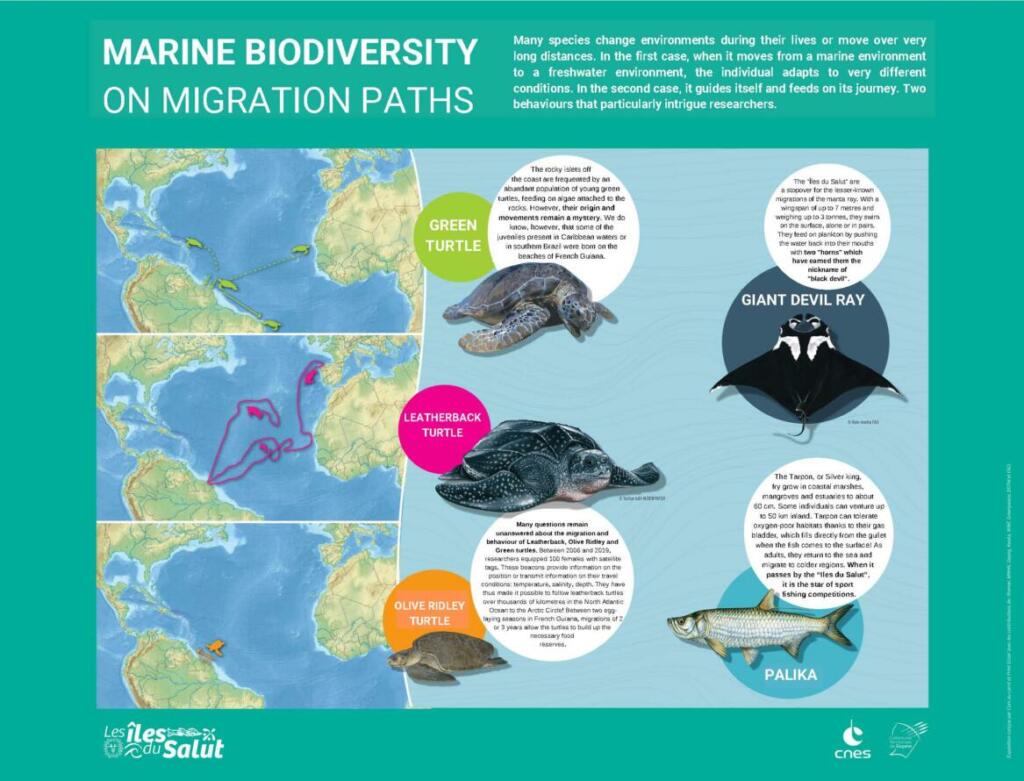
The rocky islets off the coast are frequented by an abundant population of young green turtles, feeding on algae attached to the rocks. However, their origin and movements remain a mystery. We do know, however, that some of the juveniles present in Caribbean waters or in southern Brazil were born on the beaches of French Guiana.
LEATHERBACK TURTLE
OLIVE RIDLEY TURTLE
Many questions remain unanswered about the migration and behaviour of Leatherback, Olive Ridley and Green turtles. Between 2006 and 2019, researchers equipped 100 females with satellite tags. These beacons provide information on the position or transmit information on their travel conditions: temperature, salinity, depth. They have thus made it possible to follow leatherback turtles over thousands of kilometres in the North Atlantic Ocean to the Arctic Circle! Between two egg-laying seasons in French Guiana, migrations of 2 or 3 years allow the turtles to build up the necessary food reserves.
PALIKA
The Tarpon, or Silver king, fry grow in coastal marshes, mangroves and estuaries to about 60 cm. Some individuals can venture up to 50 km inland.
Tarpon can tolerate oxygen-poor habitats thanks to their gas bladder, which fills directly from the gullet when the fish comes to the surface! As adults, they return to the sea and migrate to colder regions. When it passes by the “Iles du Salut”, it is the star of sport fishing competitions.
GIANT DEVIL RAY
The “Îles du Salut” are a stopover for the lesser-known migrations of the manta ray. With a wingspan of up to 7 metres and weighing up to 3 tonnes, they swim on the surface, alone or in pairs. They feed on plankton by pushing the water back into their mouths with two “horns” which have earned them the nickname of “black devil”.
Exhibition designed by Com au carré and Print Eclair with contributions from Ifremer, MNHN, Gepog, Kwata, WWF, Greenpeace, DGTM and FAO.