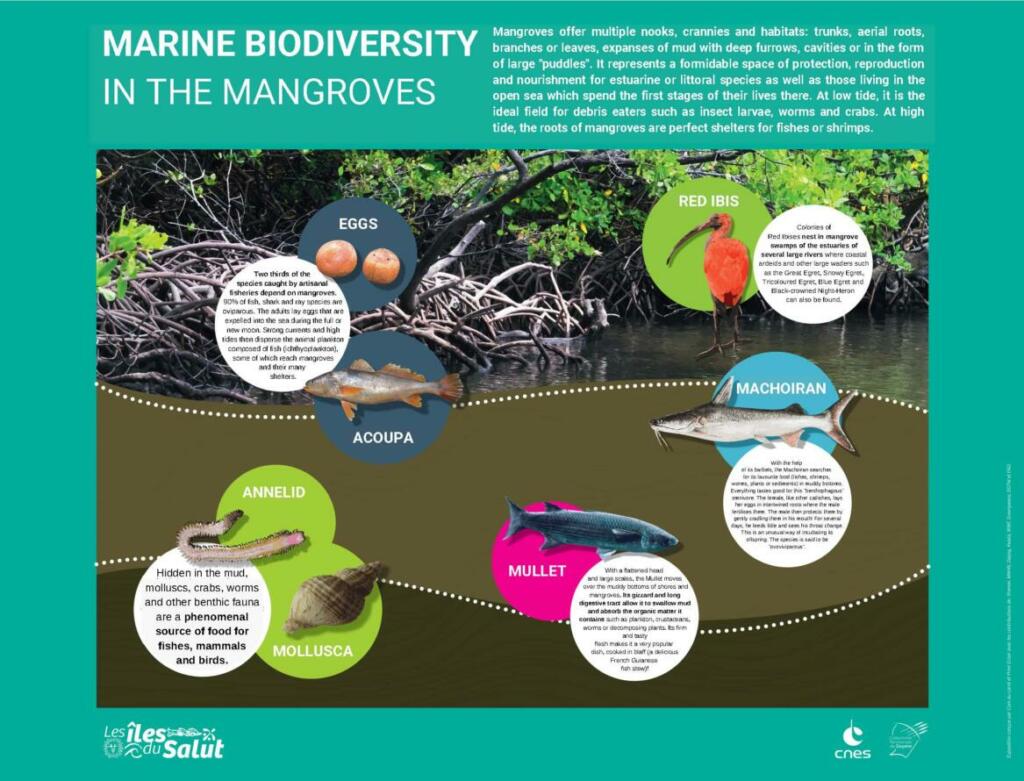
ANNELID, MOLLUSCA
Hidden in the mud, molluscs, crabs, worms and other benthic fauna are a phenomenal source of food for fishes, mammals and birds.
GREENLAND EGGS, ACOUPA
Two thirds of the species caught by artisanal fisheries depend on mangroves.
90% of fish, shark and ray species are oviparous. The adults lay eggs that are expelled into the sea during the full or new moon. Strong currents and high tides then disperse the animal plankton composed of fish (ichthyoplankton), some of which reach mangroves and their many shelters.
MULLET
With a flattened head and large scales, the Mullet moves over the muddy bottoms of shores and mangroves. Its gizzard and long digestive tract allow it to swallow mud and absorb the organic matter it contains such as plankton, crustaceans, worms or decomposing plants.
Its firm and tasty flesh makes it a very popular dish, cooked in blaff (a delicious French Guianese fish stew)!
MACHOIRAN (Crucifix catfish)
With the help of its barbels, the Machoiran searches for its favourite food (fishes, shrimps, worms, plants or sediments) in muddy bottoms. Everything tastes good for this “benthophagous” omnivore.
The female, like other catfishes, lays her eggs in intertwined roots where the male fertilises them. The male then protects them by gently cradling them in his mouth! For several days, he feeds little and sees his throat change. This is an unusual way of incubating its offspring. The species is said to be “ovoviviparous”.
RED IBIS
Colonies of Red Ibises nest in mangrove swamps of the estuaries of several large rivers in French Guiana (Mahury, Sinnamary) where coastal ardeids and other large waders such as the Great Egret, Snowy Egret, Tricoloured Egret, Blue Egret and Black-crowned Night-Heron can also be found.
Exhibition designed by Com au carré and Print Eclair with contributions from Ifremer, MNHN, Gepog, Kwata, WWF, Greenpeace, DGTM and FAO.