Their uplift is thought to be due to the weight imposed by the Amazon delta on the oceanic crust. Unique between the Amazon and the Orinoco, they are very important in the life cycles of many species: feeding, reproduction and migration passage.
The Île du Grand Connétable wildlife sanctuary is the only exclusively marine reserve of the entire Guiana Shield coastline.
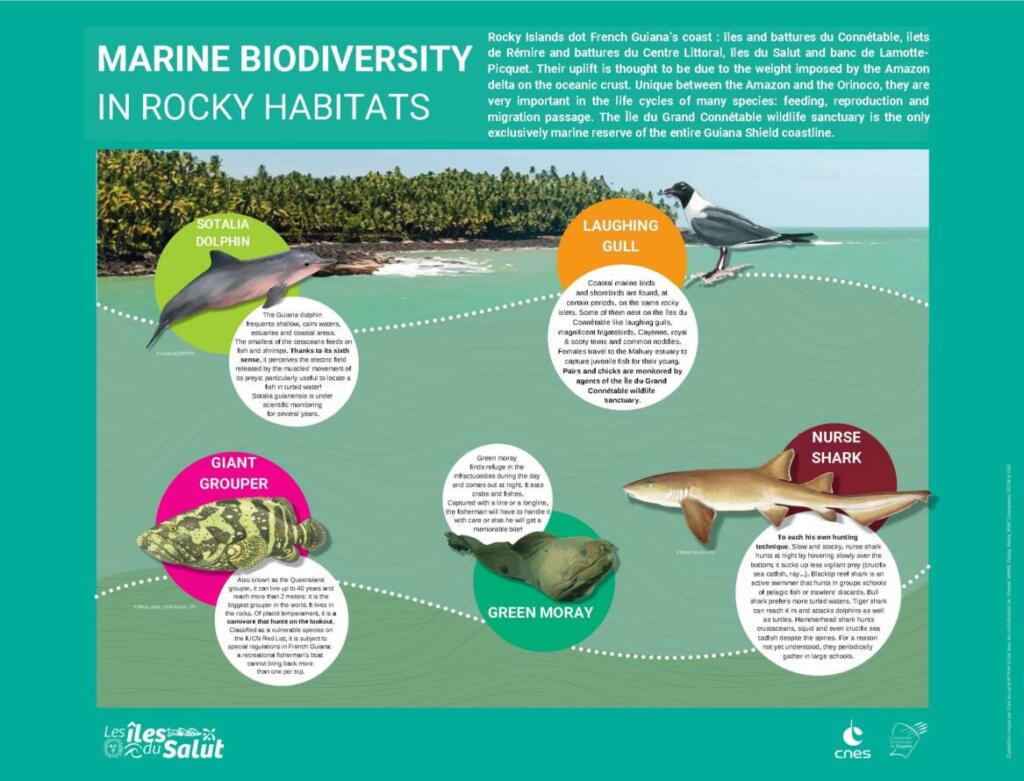
SOTALIA DOLPHIN
The Guiana dolphin frequents shallow, calm waters, estuaries and coastal areas.
The smallest of the cetaceans feeds on fish and shrimps. Thanks to its sixth sense, it perceives the electric field released by the muscles’ movement of its preys: particularly useful to locate a fish in turbid water!
Sotalia guianensis is under scientific monitoring for several years.
GIANT GROUPER
Also known as the Queensland grouper, it can live up to 40 years and reach more than 2 meters: it is the biggest grouper in the world. It lives in the rocks. Of placid temperament, it is a carnivore that hunts on the lookout.
Classified as a vulnerable species on the IUCN Red List, it is subject to special regulations in French Guiana: a recreational fisherman’s boat cannot bring back more than one per trip.
LAUGHING GULL
Coastal marine birds and shorebirds are found, at certain periods, on the same rocky islets. Some of them nest on the îles du Connétable like laughing gulls, magnificent frigatebirds, Cayenne, royal & sooty terns and common noddies.
Females travel to the Mahury estuary to capture juvenile fish for their young. Pairs and chicks are monitored by agents of the Île du Grand Connétable wildlife sanctuary.
NURSE SHARK
To each his own hunting technique. Slow and stocky, nurse shark hunts at night by hovering slowly over the bottom; it sucks up less vigilant prey (crucifix sea catfish, ray…). Blacktip reef shark is an active swimmer that hunts in groups schools of pelagic fish or trawlers’ discards. Bull shark prefers more turbid waters. Tiger shark can reach 4 m and attacks dolphins as well as turtles. Hammerhead shark hunts crustaceans, squid and even crucifix sea catfish despite the spines. For a reason not yet understood, they periodically gather in large schools.
GREEN MORAY
Green moray finds refuge in the infractuosities during the day and comes out at night. It eats crabs and fishes.
Captured with a line or a longline, the fisherman will have to handle it with care or else he will get a memorable bite!
Exhibition designed by Com au carré and Print Eclair with contributions from Ifremer, MNHN, Gepog, Kwata, WWF, Greenpeace, DGTM and FAO.