Crevalle Jack
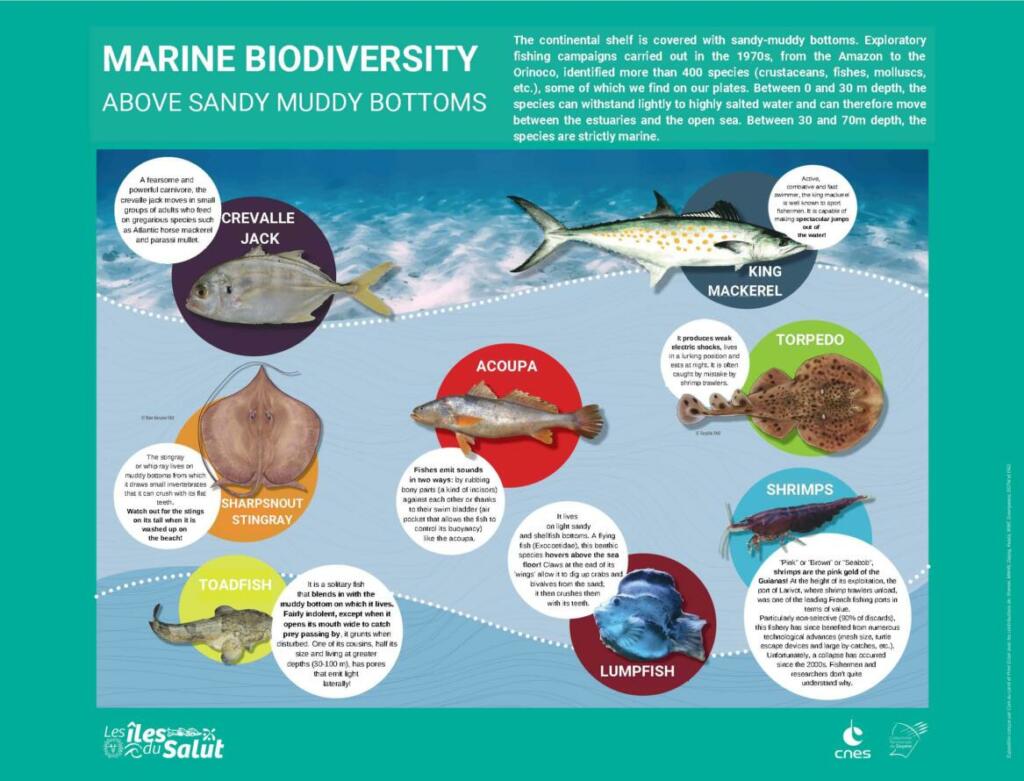
A fearsome and powerful carnivore, the crevalle jack moves in small groups of adults who feed on gregarious species such as Atlantic horse mackerel and parassi mullet.
lumpfish
It lives on light sandy and shellfish bottoms.
A flying fish (Exocoetidae), this benthic species hovers above the sea floor! Claws at the end of its ‘wings’ allow it to dig up crabs and bivalves from the sand; it then crushes them with its teeth.
King Mackerel
Active, combative and fast swimmer, the king mackerel is well known to sport fishermen. It is capable of making spectacular jumps out of the water!
TORPEDO
It produces weak electric shocks, lives in a lurking position and eats at night. It is often caught by mistake by shrimp trawlers.
Sharpsnout stingray
The stingray or whip ray lives on muddy bottoms from which it draws small invertebrates that it can crush with its flat teeth.
Watch out for the stings on its tail when it is washed up on the beach!
TOADFISH
It is a solitary fish that blends in with the muddy bottom on which it lives. Fairly indolent, except when it opens its mouth wide to catch prey passing by, it grunts when disturbed.
One of its cousins, half its size and living at greater depths (30-100 m), has pores that emit light laterally!
SHRIMPS
“Pink” or “Brown” or “Seabob”, shrimps are the pink gold of the Guianas! At the height of its exploitation, the port of Larivot, where shrimp trawlers unload, was one of the leading French fishing ports in terms of value.
Particularly non-selective (90% of discards), this fishery has since benefited from numerous technological advances (mesh size, turtle escape devices and large by-catches, etc.).
Unfortunately, a collapse has occurred since the 2000s. Fishermen and researchers don’t quite understand why.
ACOUPA (WEAKFISH)
Fishes emit sounds in two ways: by rubbing bony parts (a kind of incisors) against each other or thanks to their swim bladder (air pocket that allows the fish to control its buoyancy) like the acoupa.