In French Guiana, estuaries are extremely changeable, subjected to the influence of the tide combined with the movement of mud banks on the coast.
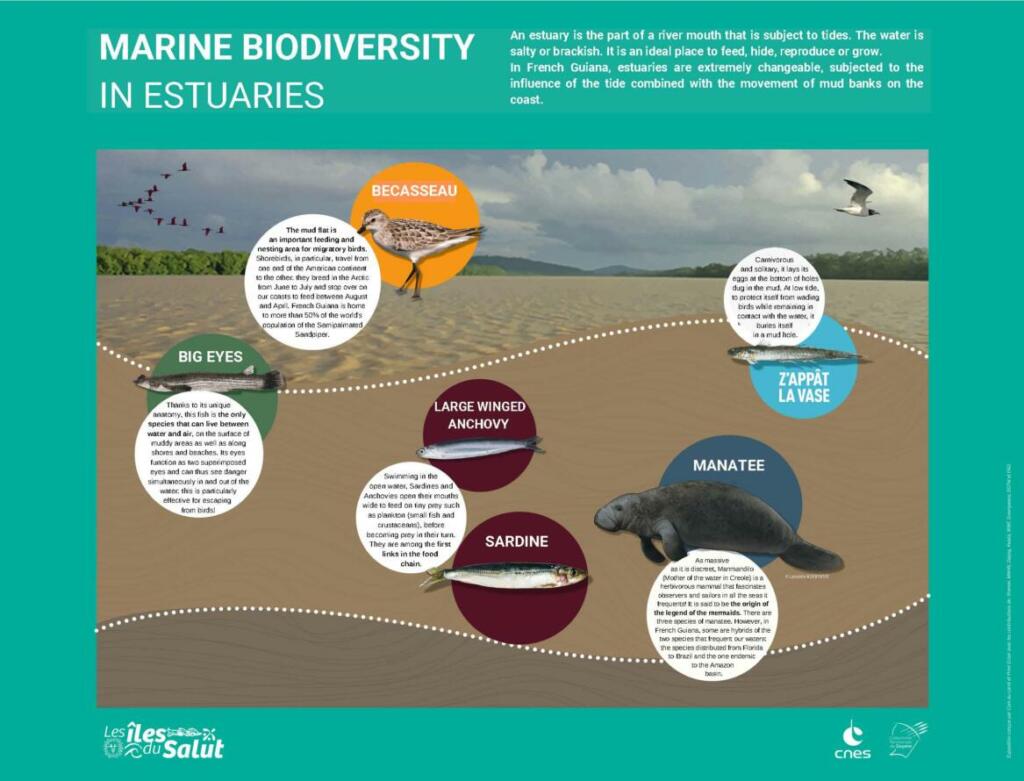
GROS-YEUX or BIG EYES
Thanks to its unique anatomy, this fish is the only species that can live between water and air, on the surface of muddy areas as well as along shores and beaches. Its eyes function as two superimposed eyes and can thus see danger simultaneously in and out of the water: this is particularly effective for escaping from birds!
LARGE WINGED ANCHOVY / SARDINE
Swimming in the open water, Sardines and Anchovies open their mouths wide to feed on tiny prey such as plankton (small fish and crustaceans), before becoming prey in their turn. They are among the first links in the food chain.
BECASSEAU
The mud flat is an important feeding and nesting area for migratory birds. Shorebirds, in particular, travel from one end of the American continent to the other: they breed in the Arctic from June to July and stop over on our coasts to feed between August and April. French Guiana is home to more than 50% of the world’s population of the Semipalmated Sandpiper.
Z’APPÂT LA VASE
Carnivorous and solitary, it lays its eggs at the bottom of holes dug in the mud. At low tide, to protect itself from wading birds while remaining in contact with the water, it buries itself in a mud hole.
MANATEE
As massive as it is discreet, Manmandilo (Mother of the water in Creole) is a herbivorous mammal that fascinates observers and sailors in all the seas it frequents! It is said to be the origin of the legend of the mermaids. There are three species of manatee. However, in French Guiana, some are hybrids of the two species that frequent our waters: the species distributed from Florida to Brazil and the one endemic to the Amazon basin.
Exhibition designed by Com au carré and Print Eclair with contributions from Ifremer, MNHN, Gepog, Kwata, WWF, Greenpeace, DGTM and FAO.